
Style over 60 isn't about chasing trends or following a list of rules for your age. It's about clothes that fit the body you have now, a skin routine short enough to actually do, and shoes that let you walk all day without thinking about your feet. That's the whole idea, for women and for men, and it's simpler than the magazines make it look.
This guide covers the wardrobe basics in full, then sums up our detailed comparisons of face moisturizers for men, sunscreen, makeup and walking shoes. Comfort first, always.
What style over 60 really means
Nobody hands out a rulebook when you turn 60, and the old ones ("no long hair after 50," "no bright colors at your age") were never true in the first place. Style over 60 simply means wearing what suits you and what feels good on your body today.
When I help someone take a fresh look at their closet, I ask four questions:
- Does it fit at the shoulders and the waist, without tugging or gaping?
- Can you sit, reach and bend in it without a second thought?
- Can you wash it at home, or does it need the dry cleaner every time?
- Do you actually reach for it, or does it just hang there?
If a piece fails the first two questions, it can go. Bodies change, and that's normal. Your clothes should change with you.
How to dress over 60: fit, fabric and care
When people ask how to dress over 60, they're usually asking something else: "Why don't my clothes look right anymore?" Most of the time, the answer is fit.
Fit comes first
Clothes that are too big hang and add bulk. Clothes that are too tight pull across the back and the hips. Neither one is comfortable. A few quick checks:
- Shoulders: the shoulder seam should sit right at the edge of your shoulder, not halfway down your arm.
- Waist: a soft, flat elastic waist or a side zip often feels better than a tight button. Look for waistbands that lie flat and don't bunch.
- Length: trousers that just touch the top of your shoe look neat. Too long and they drag.
A good tailor is worth finding. A simple hem or a waist taken in can make a thrift-store find look like it was made for you.
Fabrics that feel good
Skin often gets drier and more sensitive with the years, so fabric matters. Soft cotton, linen and cotton blends breathe well in warm weather. Fine merino wool is warm without the itch many people remember from old sweaters. A little stretch (look for elastane or spandex on the label) helps trousers and tops move with you and hold their shape.
Before you buy, rub the fabric on the inside of your wrist. If it scratches there, it will scratch all day.
Easy to care for
Read the care label before you fall in love with a piece. "Machine wash cold, tumble dry low" is the phrase you want to see.
A few habits keep clothes looking good longer:
- Wash knits inside out and dry them flat so they keep their shape.
- Use a fabric shaver to remove little pills on sweaters. It takes a minute and makes an old favorite look fresh; fabric shavers are easy to find.
- Hang jackets and coats on wide, shaped hangers so the shoulders don't stretch.
- Retire anything faded, stretched out or permanently stained. That's usually what makes an outfit feel worn out.
When buttons and zippers get harder
If small buttons or back zippers have become a struggle, pull-on trousers with a flat front, cardigans with larger buttons, and shoes with hook-and-loop straps or elastic laces all save time and still look sharp.
A small wardrobe you actually wear: the 3-3-3 idea
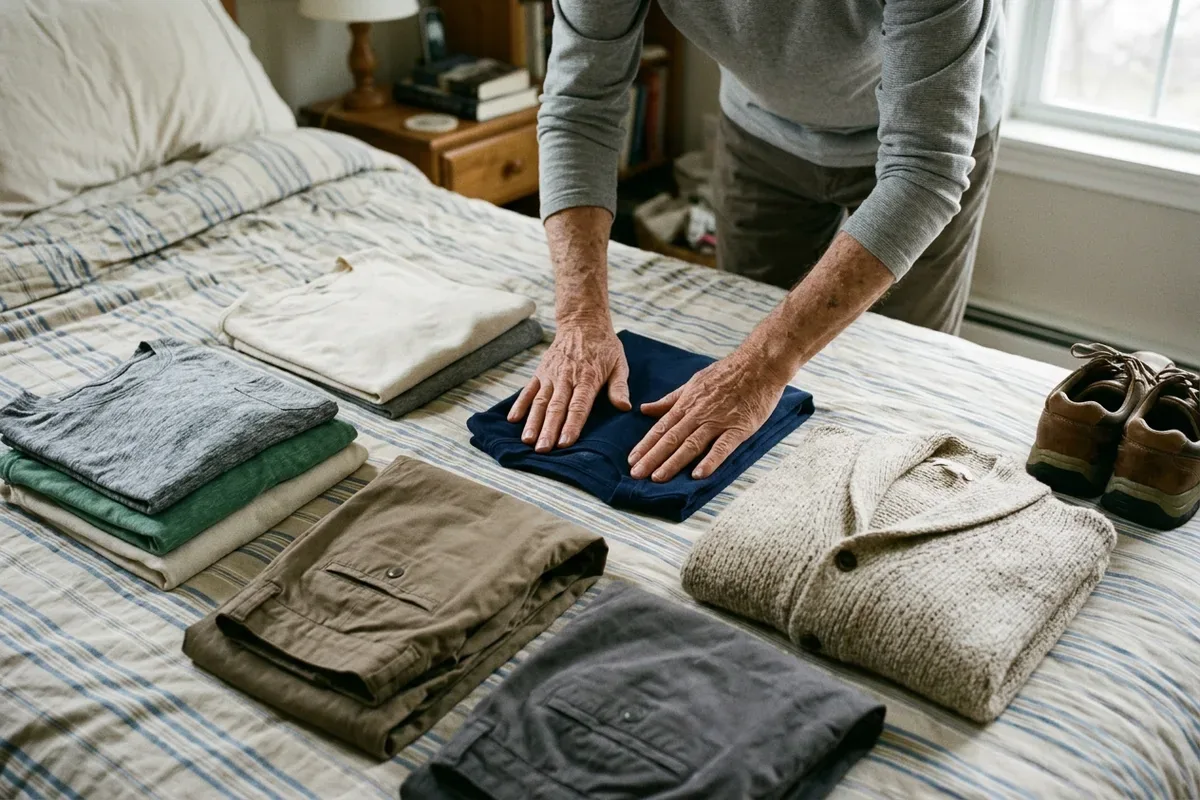
Many of us wear only part of what's in our closets. A smaller wardrobe of things you love makes getting dressed easier.
You may have heard of the 3-3-3 rule. People tell it in slightly different ways, but a common version goes like this: choose 3 tops, 3 bottoms and 3 pairs of shoes, and wear only those for about three weeks. It's not a law. It's a game that shows you, very quickly, what you really reach for.
Here is a simple way to start a capsule for her or for him:
- Pick two or three base colors you like and that go together, such as navy, gray, camel, black, olive or cream. These are your trousers, skirts, jackets and shoes.
- Add colors you love near your face in tops and scarves. A soft blue, a warm coral or a deep green can brighten your whole look.
- Choose one or two layers, like a cardigan and a light jacket, that go over everything.
- Keep one "going out" outfit ready, so a dinner invitation never turns into a closet crisis.
For her, a simple capsule might be dark ankle trousers, a pair of jeans that fits well, a knit skirt or dress, three or four soft tops, a cardigan, a light jacket and two pairs of comfortable shoes. For him, think dark jeans, chinos, a few collared shirts or polos, a crew-neck sweater, a casual jacket and two pairs of good shoes.
Clothes for women over 60 and men's clothes don't need to be "senior" versions of anything. A capsule built on style over 60 basics just needs pieces that fit, feel good and match, so any top works with any bottom.
Men's fashion over 60: easy wins for him
A lot of men stop thinking about clothes around retirement, until the favorite shirts are all a size off. The good news: men's fashion over 60 is refreshingly simple.
- One pair of trousers that really fits. Dark chinos or dark jeans, hemmed to the shoe, look sharp with almost anything.
- Shirts with a collar that sits right. If the collar gaps or pinches, the shirt is the wrong size, no matter how nice the pattern is.
- A casual jacket or a navy blazer. It turns jeans and a polo into an outfit for lunch out or a family event.
- A belt and shoes that go together. Brown with brown, black with black. It's an old rule, and it still works.
- Clean shoes. A quick wipe before you leave the house matters more than the brand.
Grooming counts too: trimmed nails, tidy eyebrows and moisturized hands. Which brings us to skin.
Best face moisturizer for men: a simple routine for him
Many men over 60 have never had a skin care routine, and they don't need a complicated one now. You do not need ten products. A gentle cleanser, a moisturizer and sunscreen cover the basics, and our comparison of the best face moisturizer for men explains how to pick the one he'll actually use.
The American Academy of Dermatology's public skin care advice is refreshingly practical, and it works for men too: wash your face gently, moisturize, apply sunscreen, and take care when shaving. Skin tends to get drier with age, so a mild, fragrance-free cleanser and lukewarm water are kinder than harsh bar soap and a hot scrub.
The guide compares the main types side by side:
- Light lotion: thin and quick to absorb, a good first choice for most men.
- Rich cream: thicker, often preferred in winter or in dry, heated rooms.
- Moisturizer with SPF: broad-spectrum SPF 30 or higher in the morning covers two steps at once.
- After-shave balm: a softer option than an alcohol splash, as long as it's fragrance-free.
- Three-step set: a tidy gift for a man starting from zero, if he'll use every piece.
It also covers shaving, how to read a label ("hypoallergenic" has no federal definition, the FDA explains) and how to help him start. In our house, I'm the one my husband and our sons ask, and the trick is always the same: talk about comfort, never about looks. If a product stings, burns or leaves the skin red, stop using it.
Best sunscreen for older skin: mineral, chemical or tinted
If you only add one thing to your morning, make it sunscreen. Our comparison of the best sunscreen for older skin explains the main options and how to use them well.
The American Academy of Dermatology recommends a sunscreen that says broad spectrum, has an SPF of 30 or higher, and is water resistant. The Food and Drug Administration (FDA) explains that "broad spectrum" on the label means the product passed a test for protection against both UVA and UVB rays. The FDA also requires an expiration date unless the maker has shown the product stays stable for at least three years; if there's no date, write the purchase date on the bottle.
The guide compares the types:
- Mineral (zinc oxide, titanium dioxide): an option for sensitive skin, though it can leave a white cast.
- Chemical: usually rubs in clear and feels light.
- Tinted: blends in and can stand in for a light foundation.
- Moisturizer with SPF, stick or spray: handy shortcuts for daily errands and touch-ups.
The details that matter most are simple. Use enough: the AAD says most adults need about 1 ounce, roughly a shot glass full, to cover the body. Reapply at least every two hours outdoors, and after swimming or sweating. Add a wide-brimmed hat, sunglasses and shade; the FDA suggests limiting time in the sun between 10 a.m. and 2 p.m. General information from personal experience, not medical advice.
Best makeup for mature skin: five simple steps
Makeup is a choice, not a duty, and it's only one small part of style over 60. If you enjoy it, the goal is a fresh, natural look that feels like you. Our comparison of the best makeup for mature skin sets out the main types and keeps the routine to five steps.
A few ideas run through the whole guide:
- Start with skin care. Moisturizer and sunscreen go on first, so makeup sits on comfortable skin.
- Pick a light base. A tinted moisturizer or a light liquid foundation usually feels better than heavy powder. A primer is optional; a good moisturizer often does the same job.
- Test shades on your jawline, in daylight, not on the back of your hand.
- Bring back a little color. A soft cream blush and a lip color close to, or a little deeper than, your natural lip color brighten your face in seconds.
- Frame the eyes. Brows often get lighter with the years, and filling them in with a fine pencil makes a big difference. Brown or brown-black mascara looks softer than jet black.
The guide also covers FDA safety basics for cosmetics: don't share eye makeup, keep lids closed, and toss products that change smell, color or texture. If anything makes your eyes sting or your skin itch, stop using it right away.
Best walking shoes for seniors: what to compare
Shoes can make or break your day. If your feet hurt, you walk less and go out less. Our guide to the best walking shoes for seniors compares the main types rather than ranking brands.
- Cushioned: a thick, soft sole many people love on pavement; some find tall soles a bit tippy.
- Stable: a firm heel, a firmer middle and a wider base, for less wobble.
- Hook-and-loop straps: quick and easy on stiff fingers.
- Hands-free slip-ons: step in without bending, as long as the heel stays put.
- Wide widths: the same shoe, cut wider, for a snug feeling across the ball of the foot.
Whatever the type, here is what I look for: a firm heel counter, a roomy toe box, a sole that bends at the ball of the foot and a tread with real grip. Try shoes on later in the day, when feet are at their largest, and walk on a hard floor, not only the carpet. Walking shoes shouldn't need breaking in. A long-handled shoehorn saves bending, too; long-handled shoehorns are easy to find.
The guide also explains the APMA Seal of Acceptance: a program run by the American Podiatric Medical Association that manufacturers apply to and pay for. It can be a useful clue, but it's not an independent test of every shoe. For simple daily habits, including walking, see our guide to health tips for seniors.
Shopping for style over 60 on a budget
Style over 60 has nothing to do with spending a lot. I love a good thrift store, and some of my favorite jackets came off a secondhand rack here in Charlotte, then went straight to the tailor for a hem. Here is how to shop smart:
- Make a short list first, so you don't come home with a fifth striped shirt.
- Try everything on sitting down. If it pulls or digs when you sit, you won't wear it.
- Check seams, zippers and buttons before you pay, especially at secondhand stores.
- Read the return policy. Online, look for free returns and a clear return window before you order.
- Ask about discounts. Many stores offer a day or a percentage for older shoppers. Our list of senior discounts shows where to look and how to ask.
A word about the few product links on this page: we haven't tried these items ourselves. Everything we mention is Researched: we explain what to look for, so you can compare for yourself.
Style over 60 for him and for her: putting it together
Here's how the pieces fit together on an ordinary Tuesday:
- Morning: wash your face, moisturize, put on sunscreen. Two minutes, tops.
- Getting dressed: a base (dark trousers or jeans), a top in a color you like, one layer and your walking shoes.
- Heading out: hat and sunglasses if it's sunny, and a small tube of sunscreen in your bag or pocket.
Style over 60 is mostly small habits that add up. Start with whatever bothers you most: sore feet, clothes that never feel right, or skin that feels tight.
Frequently Asked Questions
How should a 62-year-old woman dress?
However she likes, as long as the clothes fit and feel good. Start with pieces that sit right at the shoulders and waist, fabrics with a little stretch, and colors you enjoy near your face. Add one layer, like a cardigan or a light jacket, and shoes you can walk in. There's no age rule on length, color or prints. Fit and comfort matter far more than the number on your birthday cake.
How do you not look frumpy at 60?
Frumpy almost always comes from fit, not from age. Clothes that are too big add bulk, and clothes that are too tight pull. Check that shoulder seams sit on your shoulders, hem trousers so they just touch your shoes, and retire anything faded, pilled or stretched out. A simple hem from a tailor and clean, comfortable shoes change the whole look.
What is the 3-3-3 rule for clothes?
It's a popular capsule wardrobe game, and people tell it in slightly different ways. A common version: pick 3 tops, 3 bottoms and 3 pairs of shoes, then wear only those for about three weeks. You quickly learn which pieces you reach for and which ones you can pass on. Treat it as an experiment, not a strict rule.
How can I look trendy at 60?
Pick one current detail and wear it with the basics you already love. That could be a new color, a looser trouser shape, a pair of clean white sneakers or a modern pair of glasses. One fresh piece looks confident. A whole outfit copied from a trend page rarely feels like you, and it's hard on a budget.
One thing to try this week
Pull out the three pieces of clothing you wore most last month and the three you haven't touched in a year. Look at what the favorites have in common: the fit, the fabric, the color. That's your style. Next time you shop, bring that short list with you, and let the rest go.
Sources
- American Academy of Dermatology, Sun protection
- American Academy of Dermatology, Skin care basics
- U.S. Food and Drug Administration, Cosmetics
- U.S. Food and Drug Administration, Sunscreen: How to help protect your skin from the sun
- U.S. Food and Drug Administration, Hypoallergenic cosmetics