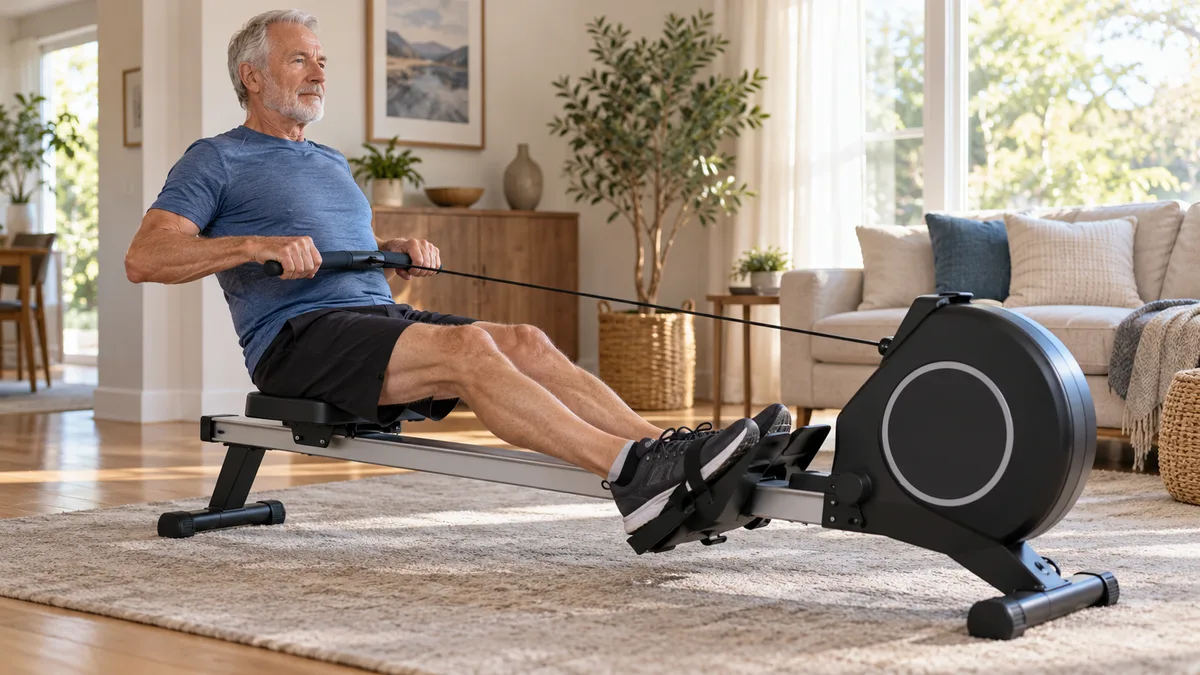
A rowing machine gives you a low-impact workout that moves your arms, legs, back and core together, without the impact of running or the repetitive motion of a stationary bike. This guide compares the main types of rowing machine for home use and explains what to look at before you buy. It is part of our wider guide to exercise equipment for seniors, which covers everything from resistance bands to compact ellipticals.
Why a rowing machine suits home use
The NIA describes strength and endurance activities as two of the four types of exercise that matter for older adults. Rowing covers both in a single motion: the leg drive builds lower-body strength, and the sustained effort builds endurance. The CDC's physical activity guidance for older adults supports activities that work the muscles and get the heart rate up gently, and rowing fits both.
What I like about a rowing machine for home is that you set the pace. Low resistance and slow strokes make it accessible from almost any starting point. There is no minimum speed to keep up with, no class schedule and no waiting for a machine.
At the community center near my house, a staff member once showed me the stroke order on one of their rowing machines. It took about five minutes to get it right. Once you have it, the motion feels natural. That's the part worth learning before you buy anything.
The main types compared
Every type on this page carries our Researched label: descriptions come from public product pages and manufacturer specifications. We did not test any of these products, and no brand is ranked.
| Type | Resistance feel | Noise level | Good for | Watch out for |
|---|---|---|---|---|
| Magnetic | Smooth, adjustable with a dial | Very quiet | Home use, apartments, beginners | Some feel less realistic than gym machines |
| Air | Increases with effort | Louder fan sound | A more athletic feel | Noise, no fixed resistance setting |
| Water | Smooth, natural pull | Gentle water sound | A realistic stroke, calming to use | Heavy tank, higher price |
| Hydraulic (piston) | Arms move independently | Quiet | Small spaces, lowest price | Less natural motion, arms work separately |
Magnetic rowing machines (Researched)
Magnetic resistance uses a flywheel and magnets. You turn a dial or press a button to change the resistance level. The stroke is smooth and consistent, and the machine runs quietly enough to use while watching TV or listening to the radio.
Good for: anyone starting out, anyone in an apartment or a shared home, and older adults who want a simple, repeatable experience. Limits: the feel is more mechanical than water or air; some people find the stroke less satisfying over time. What to look at: the number of resistance levels (eight or more gives you room to progress), a seat that glides smoothly on the rail and a display you can read without leaning forward.
Air rowing machines (Researched)
Air rowers use a spinning fan for resistance. The harder you pull, the more resistance you feel. This dynamic feel is why they are common in gyms and fitness programs.
Good for: people who want a more athletic experience and don't mind some noise. Limits: you cannot set a fixed resistance level; the machine responds to your effort, which makes it harder to keep sessions consistent. What to look at: a seat height that lets you get on and off without difficulty, and a handle that doesn't require a strong grip.
Water rowing machines (Researched)
Water rowers have a tank filled with water. The paddles move through it as you row, giving a smooth, natural resistance that increases with effort. Many people find the sound of the water calming.
Good for: people who want a realistic rowing feel and have the floor space; some models double as a decorative piece of furniture. Limits: the tank adds weight, making the machine harder to move; water rowers are generally more expensive. What to look at: how the tank is filled and maintained, and the assembled weight if you plan to move it.
Hydraulic rowing machines (Researched)
Hydraulic or piston rowers use small pistons on each arm. They are the most compact and the least expensive. The arms move independently rather than together.
Good for: very small spaces and the tightest budgets. Limits: the independent arm motion does not match a real rowing stroke and can feel awkward. Less suited to longer sessions. What to look at: arm adjustment range so both sides feel balanced, and seat comfort.
What to compare before you buy
Five questions cover most of the decision:
- Can I get on and off easily? Sit height matters. Check the seat height from the floor and whether there is something to hold while you get seated.
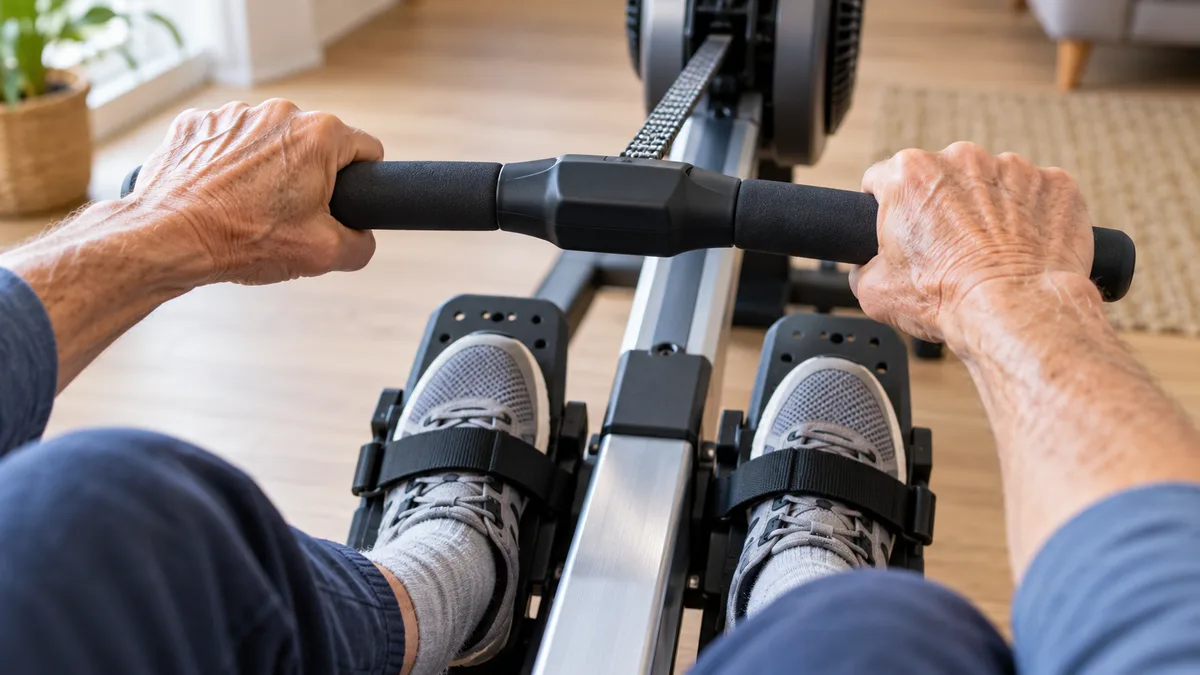
- Are the footrests easy to buckle? Straps with a simple hook-and-loop closure are easier on stiff fingers than narrow buckles.
- How quiet does it need to be? Magnetic and hydraulic machines work better in shared homes or apartments than air rowers.
- Does it fold, and does the folded size fit my space? Measure the folded footprint before you buy.
- What are the return terms? Rowing machines are heavy. Confirm whether returns are free and who arranges collection.
If you want a lower-impact option that is easier to get on and off, our comparison of the best walking pad covers compact indoor walking options.
How to get started safely
The stroke order is the one thing worth practicing before you use any resistance:
- Catch: arms straight, lean forward slightly from the hips, shins upright.
- Drive: push with your legs first; let the seat slide back before your arms move.
- Finish: lean back slightly, pull the handle to your lower chest.
- Recovery: arms extend first, then lean forward, then let your knees bend to slide forward.
Legs, then back, then arms. That's the order. Reversing it, by pulling with your arms first, is what strains the lower back.
Start at the lowest resistance. Five minutes with good form is more useful than fifteen minutes with poor form. I'd suggest spending the first two or three sessions just counting your strokes and keeping the motion smooth, before you think about time or pace.
Stop if...
- you feel any pain in your lower back, shoulders or knees;
- you feel short of breath or dizzy;
- the seat slips or the machine moves on the floor.
Slide forward on the seat, step off and rest. Place a non-slip mat under the machine if it moves. Check with your doctor before starting, and especially before rowing if you have had a back injury or back surgery.
Frequently Asked Questions
What is the best rowing machine for seniors?
For most older adults, a magnetic rowing machine is the easiest starting point: quiet, smooth and simple to adjust. Look for a padded seat, soft-grip handle, adjustable footrests with easy-to-buckle straps and a fold-flat option if space is tight.
Are rowing machines good for older adults?
Rowing is a low-impact exercise that works the arms, legs, back and core in one smooth movement. It puts less stress on the knees and hips than running. The key is learning the correct stroke order and starting at a low resistance. Check with your doctor before starting, especially if you have a back condition.
Is rowing hard on the back?
Rowing with poor form can strain the lower back. The correct order is: legs push first, then lean back slightly, then pull the handle to your chest. Pulling with the arms first and rounding the back are the two most common mistakes. Start at low resistance, move slowly, and stop if your back feels strained.
How long should a senior use a rowing machine?
Start with five to ten minutes at low resistance, focusing on smooth form. The CDC's guidance for older adults supports breaking activity into shorter sessions. Add time only when the current amount feels easy and your form stays steady.
One thing to try this week
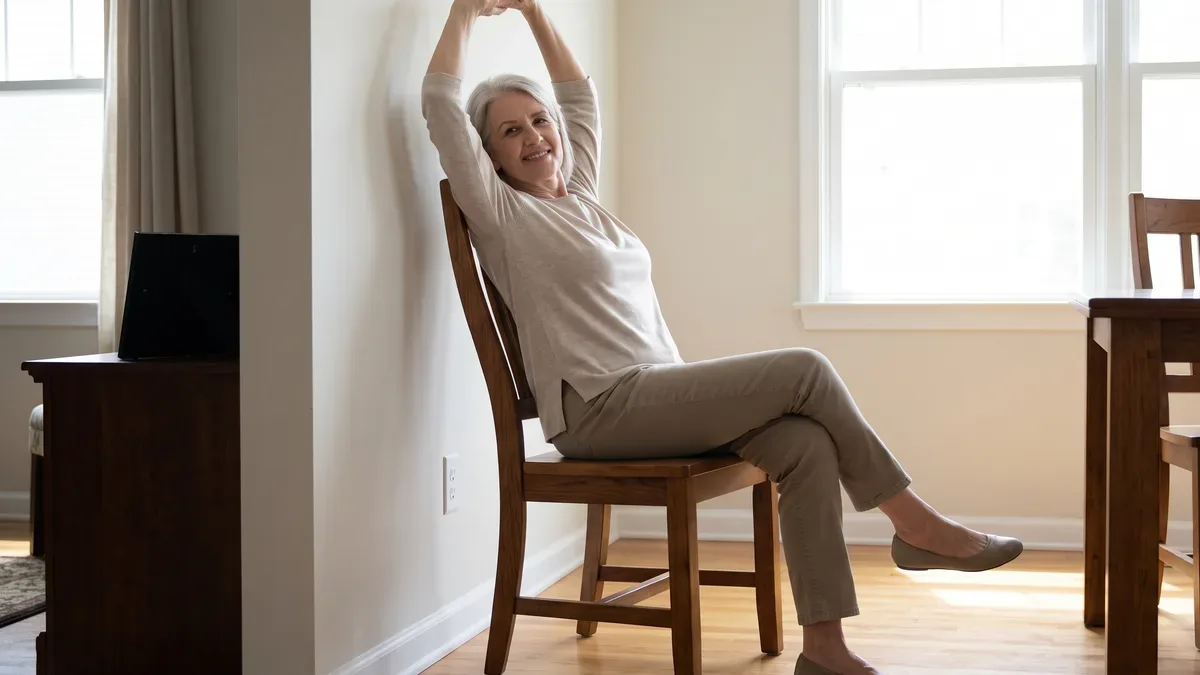
Before you buy a rowing machine, sit on a sturdy dining chair, extend your arms in front of you, push back with your feet flat on the floor and pull your hands toward your chest. That is the shape of the rowing stroke. Do it ten times slowly and notice how your back feels. If it feels comfortable, a rowing machine is worth looking at. For more simple home exercise options, go back to our guide to exercise equipment for seniors.
Sources
- National Institute on Aging, Exercise and Physical Activity: nia.nih.gov/health/exercise-and-physical-activity
- CDC, Physical Activity Basics: cdc.gov/physical-activity-basics
- CDC, Older Adult Fall Prevention: cdc.gov/falls