Chair yoga for seniors is a set of slow stretches and breathing you do sitting on a sturdy chair, so you never need to get down on the floor. This page gives you a free chair yoga for seniors routine that takes ten minutes, with an easier version of every move and a printable card at the end.
General information from personal experience, not medical advice. Check with your doctor before starting a new routine.
You need a chair and ten minutes. Start where you are. Chair yoga for seniors is one of the gentle habits in our guide to health tips for seniors, alongside walking, balance work, simple meals and better sleep.
Why chair yoga for seniors is worth ten minutes
The National Institute on Aging describes four types of exercise for older adults: endurance, strength, balance and flexibility. Chair yoga sits mostly on the flexibility side, with some gentle strength and a lot of breathing. The CDC also encourages older adults to move more and sit less, and even short sessions count.
What I like about chair yoga for seniors is how little it asks of you. I first tried these moves at my own kitchen table, on a chair I had sat on for years without a second thought. The only thing I changed was pushing it against the wall.
Gentle stretching may help support everyday things, like reaching into a cupboard.
What you need before you start
The setup matters more than the moves. Take two minutes to get it right.
- A sturdy chair. A solid dining or kitchen chair is ideal. No wheels, no rocking, no folding chair that might tip.
- A wall behind it. Push the chair back against a wall so it can't slide.
- Flat feet. Sit so both feet rest flat on the floor, about hip-width apart. If your feet don't reach, put a firm cushion or a thick book under them.
- Comfortable clothes. Anything you can move in. Shoes with a grippy sole, or bare feet on a non-slip floor. On a slick floor, a thin non-slip mat helps; see our overview of exercise equipment for seniors.
- A clear space. Move rugs, cords and small tables out of the way.
Sit toward the front half of the seat, so your back is straight but not leaning on the backrest. Rest your hands on your thighs. That's your starting position for every move.
The 10-minute chair yoga routine
This chair yoga for seniors routine has ten moves. Go through them in order. The times are a guide, not a stopwatch. Breathe through your nose if that's comfortable, and never hold your breath.
1. Tall sitting and slow breathing (1 minute)
Sit tall, as if a string were gently pulling the top of your head toward the ceiling. Let your shoulders drop. Breathe in slowly, then breathe out a little more slowly. Repeat for about a minute.
Easier version: lean back against the chair while you breathe.
2. Shoulder rolls (1 minute)
Lift your shoulders up toward your ears, roll them back, then let them drop down. Do this slowly about five times, then reverse the direction.
Easier version: just lift and drop the shoulders, without the roll.
3. Gentle neck tilts (1 minute)
Look straight ahead. Slowly tilt your right ear toward your right shoulder, only as far as feels easy. Hold for a breath or two, then come back to center. Repeat on the left. Do each side a few times.
Easier version: turn your head slowly to look over one shoulder, then the other, instead of tilting. Skip this move if you feel any dizziness.
4. Seated cat and cow (1 minute)
With hands on your knees, breathe in and gently lift your chest, looking slightly up. Breathe out and round your back, letting your chin drop toward your chest. Move slowly between the two, about five or six times.
Easier version: make the movement smaller, just a gentle rock of the upper back.
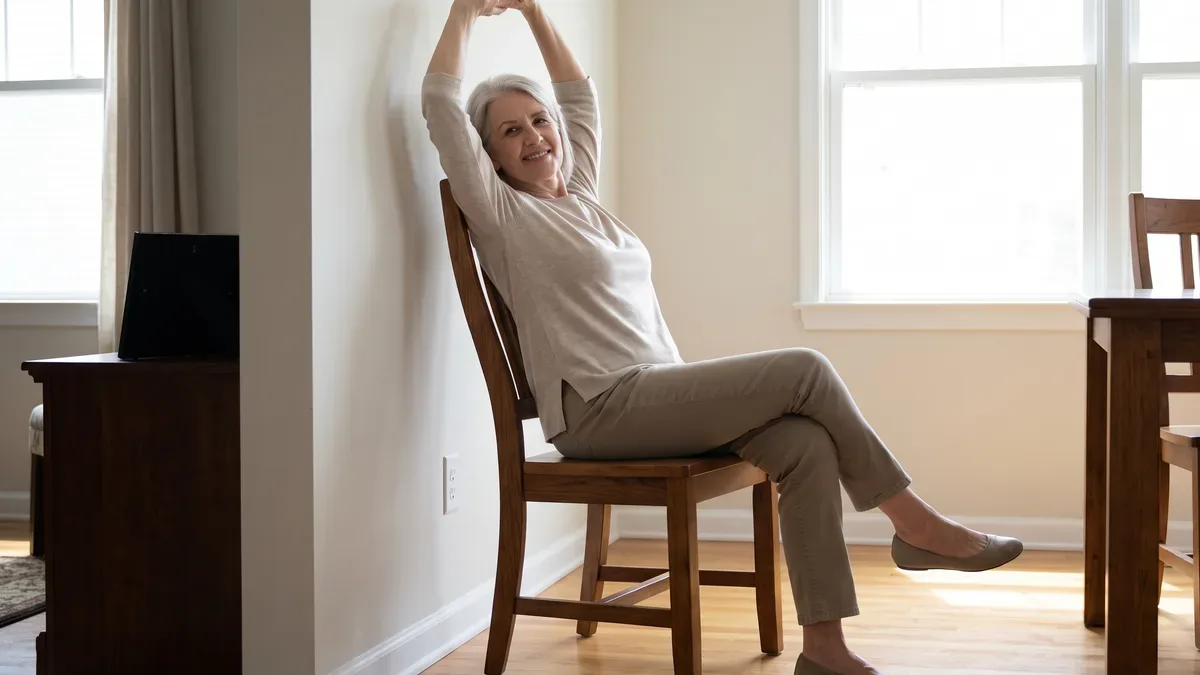
5. Overhead reach (1 minute)
Breathe in and raise both arms in front of you and up, as high as is comfortable. Breathe out and lower them to your thighs. Repeat about five times.
Easier version: raise one arm at a time, or only to shoulder height.
6. Seated side stretch (1 minute)
Place your left hand on the seat beside you. Raise your right arm up and lean gently to the left, feeling a stretch along your right side. Hold for a couple of breaths, come back up, and switch sides. Do each side two or three times.
Easier version: keep the raised hand on your head or shoulder instead of reaching overhead.
7. Seated twist (1 minute)
Sit tall. Place your right hand on your left knee and your left hand on the back or side of the chair. Breathe in to sit taller, breathe out and turn your chest gently to the left. Hold for a few breaths, return to center, and switch sides.
Easier version: keep both hands on your thighs and turn only your shoulders a little.
8. Seated marching (1 minute)
Hold the sides of the seat. Lift your right knee a few inches, lower it, then lift the left. Keep a slow, steady rhythm, like marching in place.
Easier version: lift only your heels, keeping your toes on the floor.
9. Ankle circles and foot flexes (1 minute)
Stretch one leg out a little in front of you with the heel on the floor. Point your toes away, then pull them back toward you. Draw a few slow circles with your foot in each direction. Switch legs.
Easier version: keep both feet on the floor and just lift and lower your toes.
10. Quiet rest (1 minute)
Rest your hands on your thighs, close your eyes if you like, and breathe normally. Notice how your shoulders, back and legs feel. Before you stand, open your eyes, scoot to the front of the seat and push up slowly with your hands on your thighs.
Chair yoga for seniors, printable version
Print this section or copy it onto a card and keep it by your chair. It's the whole routine at a glance.
| Move | Time | Easier version |
|---|---|---|
| Tall sitting and slow breathing | 1 min | Lean back against the chair |
| Shoulder rolls | 1 min | Lift and drop only |
| Gentle neck tilts | 1 min | Turn the head instead |
| Seated cat and cow | 1 min | Smaller movement |
| Overhead reach | 1 min | One arm, or shoulder height |
| Seated side stretch | 1 min | Hand on head or shoulder |
| Seated twist | 1 min | Hands on thighs, small turn |
| Seated marching | 1 min | Heels only |
| Ankle circles and foot flexes | 1 min | Toes up and down |
| Quiet rest | 1 min | Stay as long as you like |
Chair, against a wall. Feet flat. Slow breathing. Stop if anything hurts.
Make it a habit
A routine you do most days does more for you than a perfect one you do once. Here's what makes the routine stick for many people:
- Hook it to something you already do. After your morning coffee, or during the evening news.
- Keep the chair ready. If it's already against the wall, you're more likely to sit down and start.
- Do half on busy days. Five minutes still counts.
- Try a class. Many senior centers, libraries and community centers offer chair yoga. A teacher can check your position and suggest changes.
Once the routine feels easy, you might add a few standing moves while holding the back of the chair. Our guide to balance exercises for seniors has a simple weekly plan that pairs well with this routine. If you'd like to keep your legs moving while you sit, our comparison of the exercise bike for seniors explains how recumbent bikes and small pedal exercisers differ. And if your evenings feel restless, the slow breathing from move 1 fits nicely into a calm bedtime routine; our guide to the best mattress for seniors looks at the other half of a good night, the bed itself.
Safety: when to stop
Chair yoga for seniors is gentle, but your body always gets the final say. Move only within a comfortable range. A mild stretch is fine; pain is not.
Stop if...
- you feel dizzy or light-headed;
- you feel sharp, sudden or new pain anywhere;
- you feel unusually short of breath;
- the chair moves or feels unsteady.
Sit quietly, rest, and call for help if the feeling doesn't pass. Check with your doctor before starting a new routine.
Don't bounce into a stretch, and get up slowly at the end.
Frequently Asked Questions
Is there a free chair yoga plan for seniors?
Yes. The ten-minute routine on this page is free and printable, and you can repeat it every day. Many senior centers, libraries and community centers also run low-cost or free chair yoga classes, and the National Institute on Aging publishes free exercise guidance for older adults. A class is a good way to learn the moves with someone watching your form.
Does chair yoga for seniors really work?
It depends on what you hope for. Gentle stretching and slow breathing may help support flexibility and comfortable movement, and the National Institute on Aging counts flexibility as one of the four types of exercise for older adults. Chair yoga is a daily habit, not a fix. Think of it as a gentle way to keep moving a little every day.
Is there a chair yoga app that is free?
Some apps and many online videos offer free chair yoga sessions, though free versions often come with ads or paid upgrades. Before you pick one, check who made it, whether the instructor explains easier versions and whether it asks for payment details. A free class at your local senior center or library is another option that needs no app at all.
How often should seniors do chair yoga?
A little every day, or most days of the week, works well for many people. A short routine done often is easier to keep than a long one done rarely. Public guidance for older adults encourages moving on most days and including flexibility and balance. Go at your own pace, take rest days when you need them and check with your doctor before starting.
One thing to try this week
Put a sturdy chair against a wall today and leave it there. Each morning this week, sit down and do just the first three moves: tall sitting, shoulder rolls and neck tilts. That's three minutes. If you feel like doing more, keep going. For more small habits to build on, see our guide to health tips for seniors.
General information from personal experience, not medical advice.
Sources
- National Institute on Aging, Exercise and Physical Activity: nia.nih.gov/health/exercise-and-physical-activity
- CDC, Physical Activity Basics: cdc.gov/physical-activity-basics
- CDC, Older Adult Fall Prevention: cdc.gov/falls