An exercise bike for seniors is a stationary bike, or a smaller pedal machine, that lets you move your legs indoors while you sit. This guide compares the main types, recumbent, upright and pedal options, and walks you through the questions to ask so you can pick the one that suits your body, your room and your habits.
General information from personal experience, not medical advice. Check with your doctor before starting a new routine.
Indoor pedaling is one of the gentle habits in our guide to health tips for seniors, next to walking, chair routines and simple meals. Start where you are.
Why an exercise bike for seniors can make sense
The National Institute on Aging describes four types of exercise for older adults: endurance, strength, balance and flexibility. Pedaling falls mostly on the endurance side. The CDC encourages older adults to move more and sit less, in ways they enjoy and can keep doing. A bike at home is one way to do that when going out isn't easy.
Here in Tucson, from late spring on, my morning walk has to be done before the sun climbs. On the hottest weeks even the early hours feel too warm, and that's when I started paying attention to indoor options. An exercise bike for seniors doesn't care about the weather, the dark or an icy sidewalk.
It isn't the only answer: a walk or a chair yoga for seniors routine needs no equipment at all. A bike is one more tool, worth it if you'll use it.
The main types compared
Every type of exercise bike for seniors below carries our Researched label: the comparisons come from public product descriptions and public guidance, with no ranking. We did not try these bikes, so check the details before you buy.
Recumbent exercise bike (Researched)
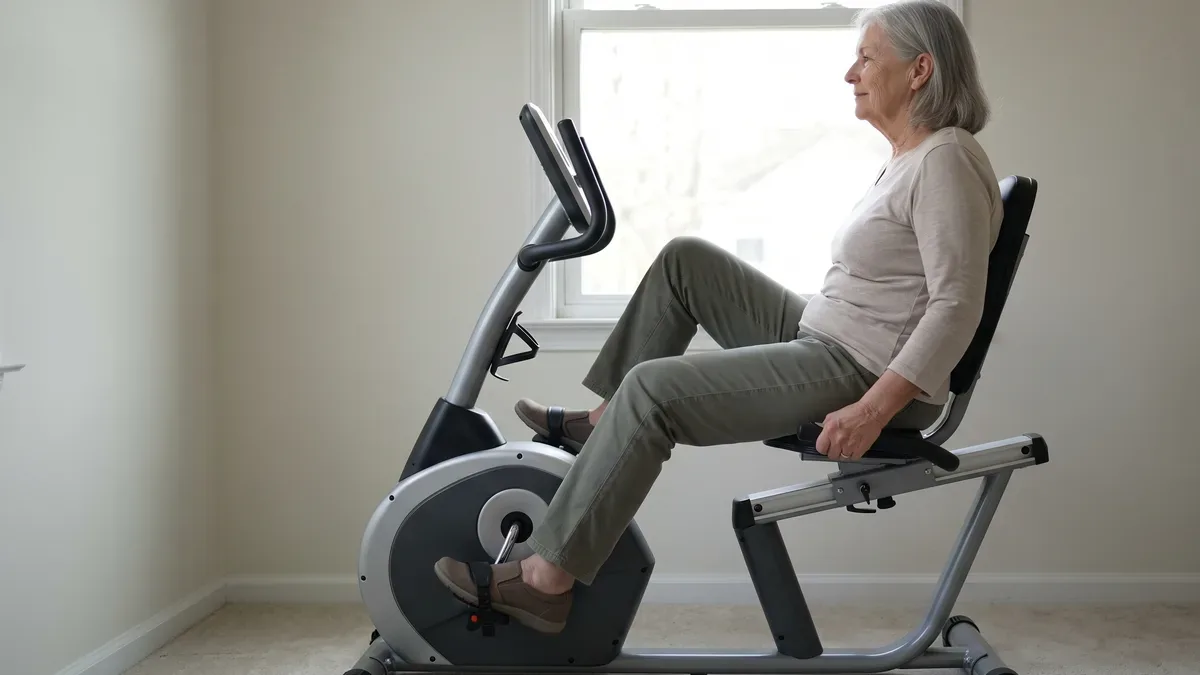
On a recumbent bike you sit in a wide seat with a backrest, pedals out in front of you. Many have a low frame you can step through.
- Good for: people who want back support, a wide seat and easy access.
- Limits: it takes more floor space than other types and is heavy to move.
- Who it suits: anyone who feels unsure climbing onto a high seat.
Well-known fitness brands such as Schwinn sell both recumbent and upright models. If you want to browse the style, look for recumbent exercise bikes with a step-through frame and a seat that slides on a rail.
Upright exercise bike (Researched)
An upright bike looks like a regular bicycle: a small seat above the pedals, handlebars in front, no backrest.
- Good for: smaller rooms, and people used to riding a bicycle.
- Limits: you lift a leg over the frame and balance on a narrow, often hard seat.
- Who it suits: people who are steady on their feet and have limited space.
Pedal exerciser and under desk bike (Researched)
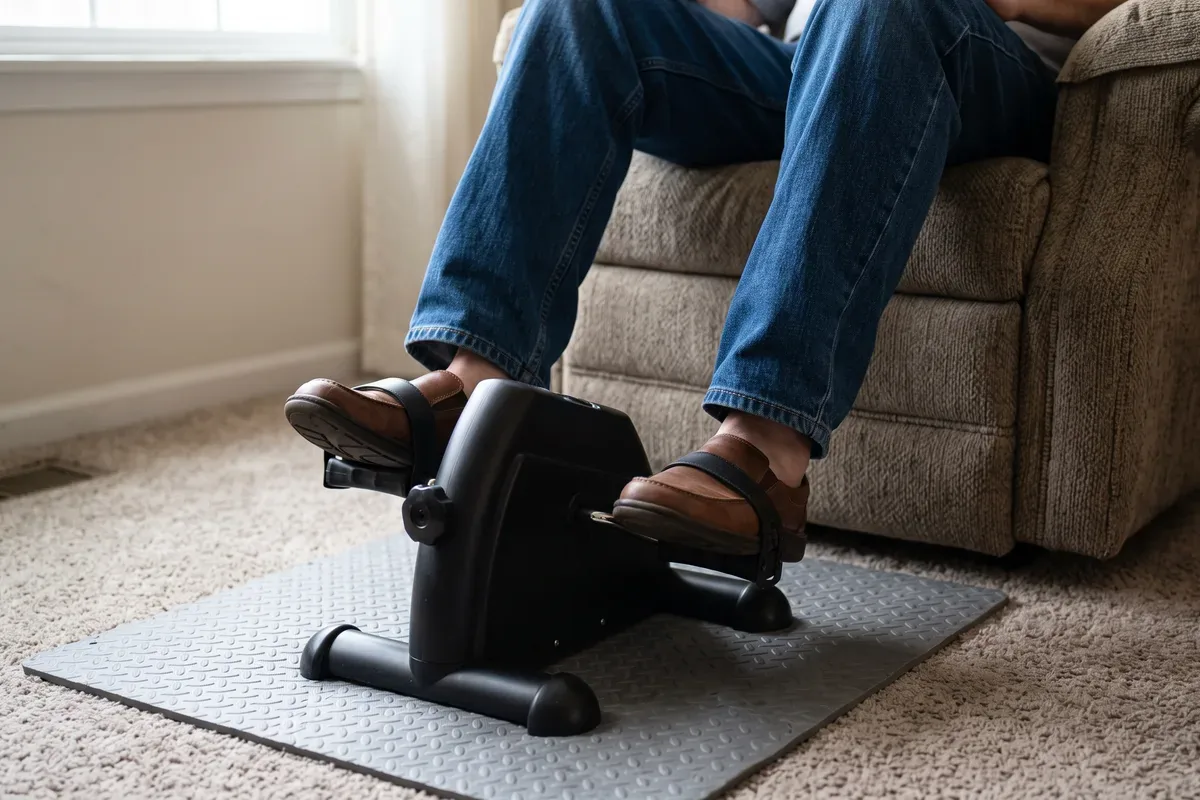
A pedal exerciser is just the pedals on a small base that sits on the floor in front of your chair. Some are sold as "under desk bikes".
- Good for: tiny spaces, low cost compared with a full bike, pedaling while you watch TV in your own chair.
- Limits: it can slide on smooth floors, it offers no seat of its own and you need a sturdy chair that doesn't roll. The motion is smaller than on a bike.
- Who it suits: people who want to start very gently, or who spend long stretches seated.
DeskCycle is one known brand of under desk bike. Whatever you look at, check that the base is wide and has rubber feet, as on most pedal exercisers sold for home use.
Recumbent cross trainer (Researched)
A recumbent cross trainer, sometimes called a recumbent elliptical or recumbent stepper, adds moving handles, so your arms push and pull while your legs step. You sit in a seat with a backrest, as on a recumbent bike.
- Good for: moving arms and legs together while seated.
- Limits: large, heavy and often aimed at gyms and clinics.
Motorized pedal machines that turn the pedals for you are often sold by medical suppliers as rehab equipment. That's a different category, outside this guide.
Quick comparison
| Type | Getting on and off | Back support | Space needed | Best fit |
|---|---|---|---|---|
| Recumbent bike | Easiest, often step-through | Yes | Large | Support and comfort |
| Upright bike | Harder, leg over the frame | No | Medium | Small rooms, steady riders |
| Pedal exerciser | Stay in your own chair | Your chair's | Very small | Gentle start, tight spaces |
| Recumbent cross trainer | Similar to recumbent | Yes | Largest | Arms and legs together |
How to choose an exercise bike for seniors
Screens and programs get a lot of attention in ads. When you pick an exercise bike for seniors, the basics matter far more. Here's the checklist I'd use.
- Easy access. Can you sit down and stand up without lifting a leg high or twisting? A step-through frame helps a lot.
- An adjustable seat. The seat should move forward and back (recumbent) or up and down (upright) so your knee stays slightly bent when the pedal is farthest from you. Check that the lever or knob is easy for your hands.
- Back support. If you like to lean back, a recumbent seat with a backrest is the obvious choice.
- Pedals that hold your feet. Wide pedals with straps keep your feet from slipping off.
- Smooth, quiet resistance. Many home bikes use magnetic resistance, which tends to be quiet.
- A display you can read. Large numbers and simple buttons.
- Maximum user weight. Every maker lists one. Check it against your own before you buy.
- Size. Measure your space, and look for front wheels so you can roll it.
If a community center near you has a bike, check first whether you can sit down without lifting your leg, and whether the seat lever is easy to pull. Those are good first questions for anyone.
Questions to ask before you buy
Big bikes arrive in heavy boxes, so a few questions can save you a hard return:
- Where will it live? A bike in a room you rarely enter gets used less.
- Is the lowest resistance gentle enough for my first weeks?
- How do returns and the warranty work?
- Can the delivery team bring the box inside?
To compare a bike with smaller gear such as bands and light weights, see our overview of exercise equipment for seniors.
A gentle first week on the bike
However you pedal, go slowly at first. This is a plan for the first week, not a target. Easier version: cut every time in half.
| Day | What to do |
|---|---|
| Monday | 5 minutes, lowest resistance, easy pace |
| Tuesday | Rest, or a short walk |
| Wednesday | 5 minutes, easy pace |
| Thursday | Rest, or a chair routine |
| Friday | 5 to 8 minutes, easy pace |
| Weekend | One short, easy ride if you feel like it |
Pedal at a pace where you can still talk. To get off, stop pedaling, sit for a moment, then stand slowly with a hand on the handles. Hook your ride to something you already do, like the morning news.
Safety: when to stop
Stop if...
- you feel dizzy or light-headed;
- you feel pain in your chest, knees, hips or anywhere else;
- you feel unusually short of breath;
- the bike or pedal exerciser slides, rocks or feels loose.
Stop pedaling, stay seated, rest, and call for help if the feeling doesn't pass. Check with your doctor before starting a new routine.
Keep the floor around your exercise bike clear of rugs and cords, wear closed shoes and keep a phone within reach. The CDC's fall prevention pages also suggest good lighting and a clutter-free home.
Frequently Asked Questions
What type of exercise bike is best for seniors?
There is no single best type. Many older adults start with a recumbent bike because the seat has a backrest, sits low and is easy to get on and off. An upright bike takes less floor space but asks more of your balance when you climb on. A small pedal exerciser suits people who prefer to stay in their own chair. Pick the one you can use safely and often.
What type of exercise bike is best for over 70 year olds?
Age alone doesn't decide it. What matters is how easily you get on and off, whether you like back support and how much room you have. A recumbent bike with a step-through frame and a seat that slides is a common choice for people in their seventies and beyond. Try one at a community center or a store first, and check with your doctor before starting.
Is riding a stationary bike the same as walking?
Not exactly, though both count as moving your body, and public guidance from the CDC encourages older adults to stay active in ways they enjoy. Walking also asks your body to keep its balance on the ground, while a bike keeps you seated. Many people mix the two: a walk on mild days and the bike when it's too hot, icy or dark to go out.
Is a pedal exerciser worth it for seniors?
It can be, if you like the idea of moving your legs while you sit in your usual chair. A pedal exerciser is small, light and easy to store. The limits: it can slide on smooth floors, it offers less support than a bike and some models need to be pushed against a chair or a wall. Use it on a non-slip mat, seated in a chair that doesn't roll.
One thing to try this week
Before you shop for an exercise bike for seniors, try one for free. Call your local senior center, community center or YMCA and ask whether they have a recumbent bike you can sit on. Pedal for five easy minutes and notice how getting on and off feels. That tells you more than any ad. For more small habits to pair with it, see our guide to health tips for seniors, and for steadiness on your feet, our plan of balance exercises for seniors.
General information from personal experience, not medical advice.
Sources
- National Institute on Aging, Exercise and Physical Activity: nia.nih.gov/health/exercise-and-physical-activity
- CDC, Physical Activity Basics: cdc.gov/physical-activity-basics
- CDC, Older Adult Fall Prevention: cdc.gov/falls